
Parapet Inspection Requirements for Your NYC Building: Height, Material & Frontage
In this article
For most New York City building owners, the question doesn't arrive in a quiet moment of planning. It arrives abruptly — as a notice from the Department of Buildings, as a sidewalk shed going up outside the building next door, or as the sudden realization that a compliance deadline is bearing down. And it tends to take the same shape: Does my building even need a parapet inspection — and if it does, what kind?
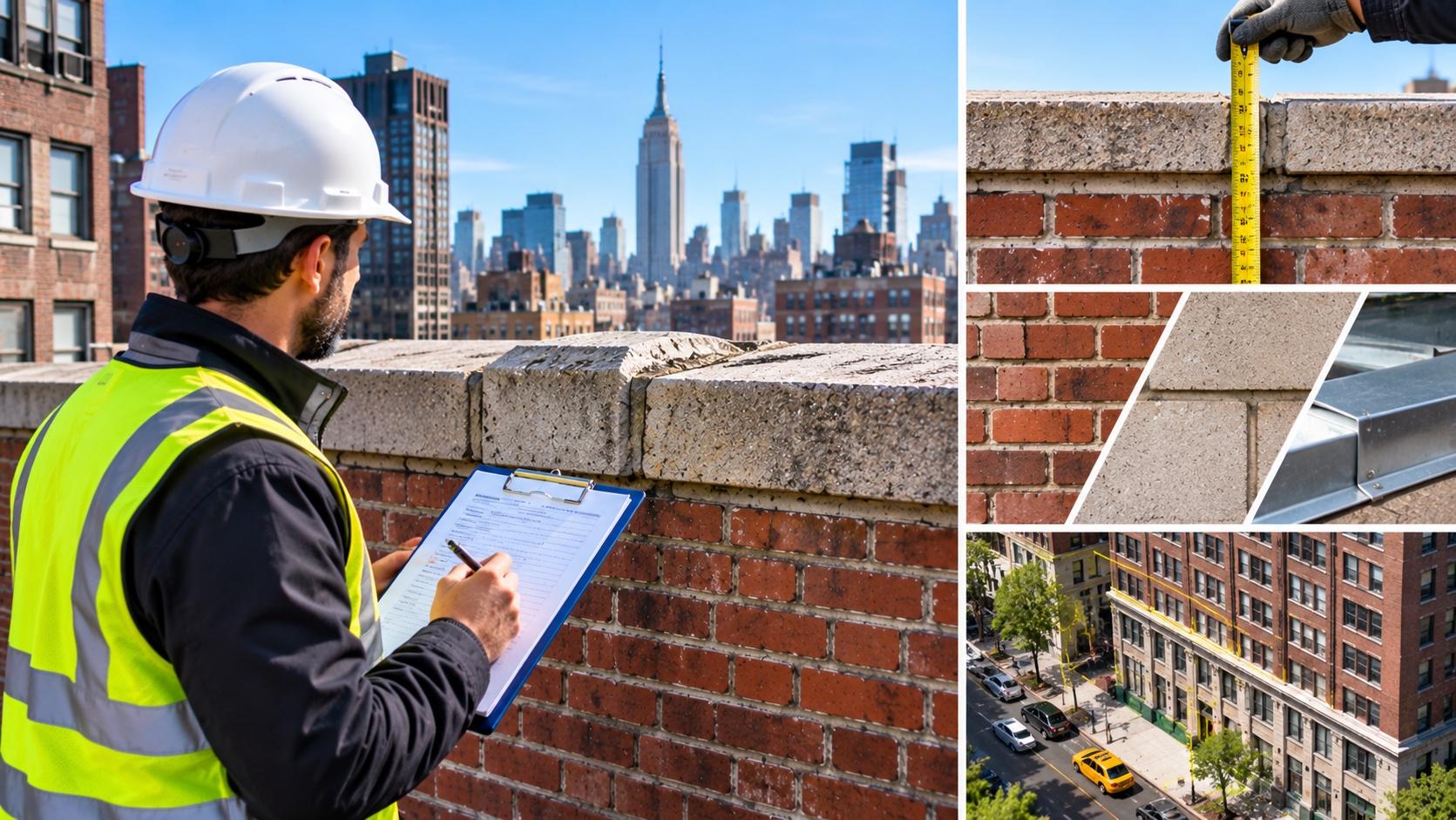
It's a fair question, and a surprisingly layered one. The honest answer is that your obligation under Local Law 126 isn't determined by a single switch that flips on or off. It's shaped by the physical reality of the parapet itself: how tall it stands above the roof, what it's built from, and — most decisively — whether it fronts a public right-of-way where pedestrians pass below.
This article is meant to serve as a diagnostic lens. We'll walk through those three factors — height, material, and street frontage — and explain how each interacts with the governing rule, 1 RCNY §103-15, to shape both the scope of your inspection and the frequency of your obligation. The goal is plain-English clarity, not legal hair-splitting, and a clear sense of your next step.
One caveat worth stating at the outset, because it genuinely matters: nothing here can give you a definitive ruling on your specific building. Applicability, scope, and classification all depend on a professional inspection of the actual structure by a qualified person. What this piece can do is help you understand why your building may carry an annual obligation — so when you book that inspection, you understand what's being assessed and why.
What Actually Triggers the Annual Parapet Inspection Requirement
Let's start with the rule itself, in plain terms.
Under Local Law 126 and its implementing regulation, 1 RCNY §103-15, owners of buildings with parapets fronting a public right-of-way are required to have those parapets observed on an annual basis. That word — annual — is the part that catches many owners off guard. This is not a once-every-few-years obligation. It recurs every single year, which means it needs a place in your ongoing compliance routine rather than being treated as a one-time task.
Here's where a common and understandable confusion creeps in. Many owners assume the parapet requirement is simply part of their facade inspection cycle. It isn't. The Facade Inspection Safety Program (FISP), often still referred to by its origins as Local Law 11, applies to buildings greater than six stories and runs on a five-year cycle with a credentialed inspection of the full exterior wall. The annual Local Law 126 parapet inspection is a separate obligation with its own cadence, its own scope, and its own applicability threshold.
In practice, this means a building can be subject to both — a FISP facade cycle and an annual parapet observation — or to the parapet requirement alone. A four-story walk-up in Brooklyn with a street-facing parapet, for instance, may fall well below the FISP threshold while still carrying an annual parapet obligation. Treating the two as interchangeable is one of the most frequent mistakes we see, and it's an easy way to miss a filing you didn't know you owed.
Defining "Public Right-of-Way" in Plain English
Because street frontage is the linchpin of the whole requirement, it's worth pausing on what "public right-of-way" actually means.
In everyday terms, a public right-of-way is any street, sidewalk, or public passage where people travel — and, critically, where a piece of failing parapet could fall and endanger someone below. The logic of the law is grounded in pedestrian safety: a parapet that overhangs a busy sidewalk presents a fundamentally different risk than one that faces an enclosed interior.
That contrast is the key to understanding applicability. A parapet enclosing an interior courtyard, or one set back from any public way with no path of pedestrian travel beneath it, may carry a different obligation — or, in some cases, none at all under this particular rule. A parapet along the front of the building, directly above the public sidewalk, is squarely the kind of condition the law is written to address.
Where it gets subtle is in the in-between cases — corner lots, shared lot lines, alleys, and unusual sightings where it isn't obvious whether a given wall "fronts" a public way. These situations don't lend themselves to armchair conclusions. Whether a specific parapet qualifies depends on the building's actual siting and the surrounding streetscape, and that's precisely the kind of determination a qualified professional should confirm rather than something you should guess at from the sidewalk.
Factor One — Height Above the Roof
The first physical factor that shapes an inspection is the parapet's height relative to the roof or walking surface behind it.
Think about the basic physics. A parapet is essentially a freestanding wall perched at the edge of a building, often with nothing bracing its back side. The taller and more exposed that wall is, the more leverage wind, thermal movement, and gravity can exert on it over time. A low, stout parapet behaves very differently from a tall, slender one that rises several feet above the roofline and catches wind like a sail.
This is why height factors so heavily into an inspector's assessment. When a qualified person observes a parapet, height informs what they scrutinize most closely:
- Overturning potential — whether the wall shows signs that it could tip outward over the building edge.
- Leaning or out-of-plumb conditions — whether the parapet has begun to tilt away from vertical, which can signal foundation movement at the wall base, mortar failure, or anchorage problems.
- Anchorage and bracing — how the parapet is tied back to the structure, if at all, and whether those connections remain sound.
- Plumbness along the run — whether the wall bows, bulges, or waves along its length rather than standing true.
A tall parapet with any of these signs warrants closer attention, because the consequences of failure scale with the mass and height of what could come down.
A word of caution here, and an important one: there is no magic number you can measure with a tape to decide, on your own, whether you're "in" or "out." Height is a factor that informs risk and scope — it is not a self-applied legal cutoff. Resist the temptation to treat it as a simple pass/fail line. It's one input a competent person weighs alongside everything else.
Guardrail and Railing Considerations
Height brings a second consideration into view. In some buildings, the parapet doubles as fall protection at the roof's edge — the thing that keeps a worker or resident from stepping off into open air. When a parapet serves that function, there may be additional guardrail or railing considerations layered on top of its stability.
We'll keep this general, because the specifics depend entirely on the building, the roof's use, and how the parapet is configured. The broader point is this: a competent person doesn't evaluate a parapet as an isolated decorative cap. They evaluate it holistically — as a structural element, potentially a safety barrier, and a piece of the building envelope all at once. That's part of why a credentialed assessment is worth more than a casual glance from someone who only sees the wall as masonry at the top of the building.
Factor Two — Material and How It Behaves Over Time
If height tells you how much is at stake, material tells you how a parapet is likely to fail — and therefore what an inspector is looking for.
New York's building stock is wonderfully varied, and so are its parapets. Across the five boroughs you'll find:
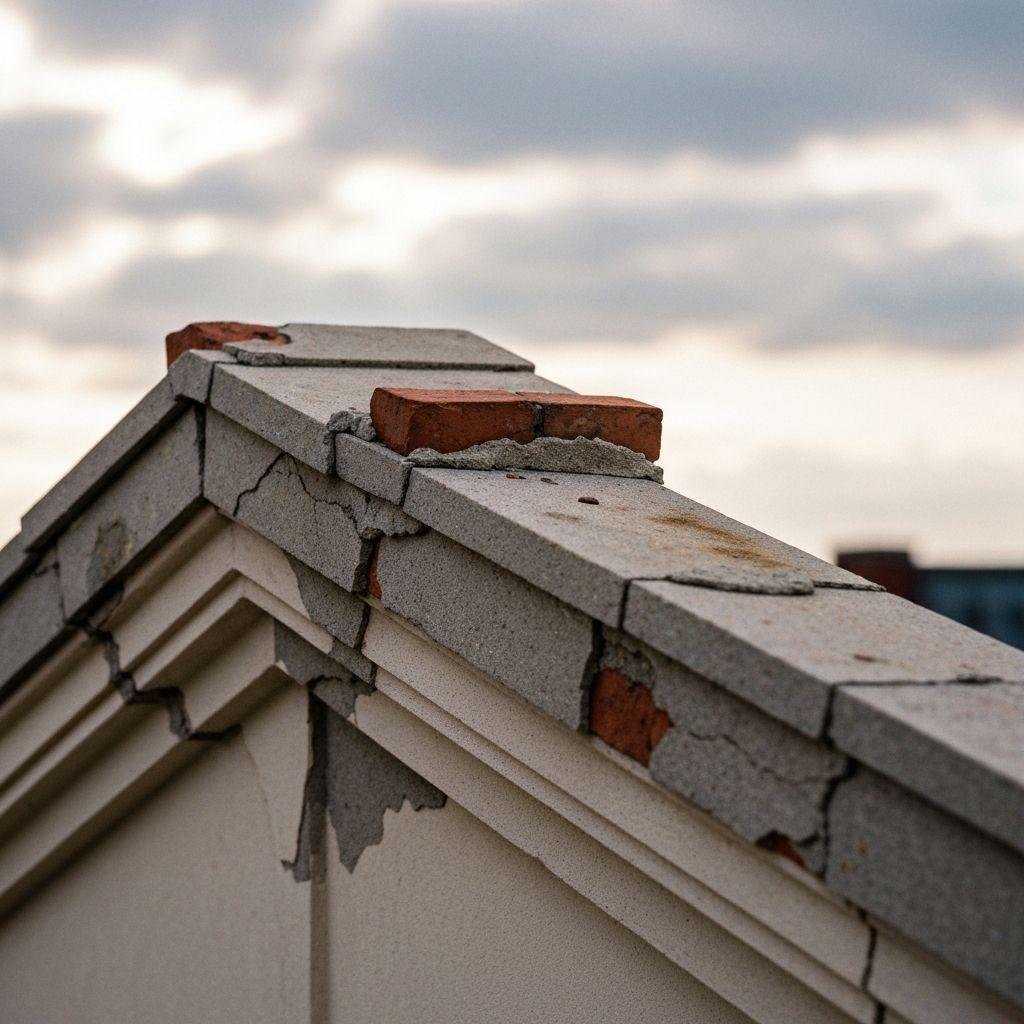
- Brick and masonry parapets, by far the most common on older residential and mixed-use stock, fail primarily through mortar deterioration, displacement, and bulging.
- Stone parapets and copings, where the concern often centers on cracked, loose, or shifted stone units and the joints between them.
- Metal parapets and metal-capped assemblies, where corrosion, loosened fasteners, and separation at seams drive the risk profile.
- Combination assemblies, where masonry, stone coping, and metal flashing all meet — and where the junctions between materials become prime spots for water intrusion and failure.
Material matters because each of these behaves differently under decades of NYC weather. A competent person doesn't apply a single checklist to every wall; they adjust their scrutiny to the failure modes the material invites. Corrosion tells one story; crumbling mortar tells another.
Why Pre-War Parapets Demand Extra Attention
Nowhere does material matter more than in the city's enormous inventory of pre-war buildings — the brownstones, tenements, and apartment houses that define so much of Manhattan, Brooklyn, and the Bronx, with plenty of counterparts in Queens and on Staten Island.
Many of these parapets were laid up with soft lime mortar, which was standard for its era. Lime mortar has real virtues, but longevity under a century of New York freeze-thaw cycles isn't always one of them. Over decades, several interacting problems tend to emerge:
- Mortar deterioration, where the joints between bricks soften, erode, and lose their binding strength, leaving the wall increasingly reliant on friction and gravity alone.
- Freeze-thaw damage, where water penetrates the masonry, freezes, expands, and progressively fractures the material from within — a cycle that repeats every winter.
- Water infiltration, which accelerates everything else and often reaches the hidden steel inside the wall.
- Corroded and rusted steel anchors, where embedded metal ties expand as they rust, cracking and displacing the surrounding masonry in a process sometimes called oxide jacking.
- Bulging and displacement, the visible outward result of all the above — a parapet that no longer stands plumb and true.
These are not hypothetical concerns. They are the everyday realities of aging masonry across the city, and they're exactly why pre-war parapets reward careful, professional attention. If your building predates the Second World War, it's worth understanding the particular vulnerabilities at play; our deeper discussion of the common parapet problems in pre-war NYC buildings walks through them in more detail.
None of this means an older parapet is doomed — many are in sound condition and simply need routine observation to stay that way. It means the material and its age are part of the story that determines how closely the wall needs to be watched.
Factor Three — Street Frontage (The Pivotal Trigger)
Of the three factors, street frontage is the one that most directly activates the obligation. Height and material shape how a parapet is assessed; frontage is a central part of whether the annual requirement applies at all.
The reasoning is straightforward once you see it from the law's point of view. A parapet facing a public way sits above the place where pedestrians walk, where deliveries are made, where children pass on their way to school. The stakes of a failure there — to safety and to liability — are at their highest. That's why a parapet facing a public right-of-way is the archetype the annual requirement is built around.
By contrast, a parapet that faces an interior courtyard, an enclosed light well, or a space with no public pedestrian travel below it occupies a different risk category, and may carry a different obligation — or none — under this rule. The wall might be identical in height and material to its street-facing counterpart, yet its relationship to the public way changes the compliance picture.
This is also why you can't always generalize from one building to another, even on the same block. Two neighboring structures can carry different obligations depending on how their parapets relate to the street, the sidewalk, and any public passage around them. The frontage question is specific, and it rewards a specific answer.
Why Frontage Raises the Liability Stakes
It's worth connecting the compliance point to the human one, because in New York's dense streetscapes they're inseparable.
A failing street-facing parapet is not only a line item on a compliance checklist. It is a genuine pedestrian-safety matter in a city where millions of people walk beneath building edges every day. A piece of displaced coping or a section of bulging masonry above a crowded Manhattan sidewalk is a risk with real consequences — for the people below and for the owner who is responsible for the asset.
We state that plainly, not to alarm anyone. The vast majority of parapets, observed on schedule and maintained sensibly, never become a danger to anyone. The point is simply that frontage is where compliance and safety converge, and it's why the law draws its line where it does. Attending a street-facing parapet is both a legal obligation and responsible stewardship of a building that shares its edges with the public.
How the Three Factors Interact Under 1 RCNY §103-15
Here's the synthesis that ties everything together: height, material, and frontage don't operate in isolation. Under 1 RCNY §103-15, they combine to shape the scope of the inspection, the depth of scrutiny a competent person applies, and — through the frontage question above all — whether the annual obligation attaches in the first place.
A tall pre-war masonry parapet fronting a busy sidewalk represents the convergence of all three factors at their most demanding: significant height, a material prone to age-related failure, and the highest-stakes frontage. A low, modern, well-anchored parapet on an interior-facing wall sits at the other end of the spectrum. Most buildings fall somewhere in between, which is exactly why a single factor can't settle the matter and why no two assessments are quite alike.
This is also the point at which we have to repeat the essential caveat, because it's the most important sentence in the entire article: whether a given parapet is covered by the annual requirement — and, if it is, how it ultimately classifies — depends on a professional inspection of that specific building. These three factors help you understand why. They don't substitute for a qualified person standing on the roof and making the call. Nothing here is legal advice; it's context to help you ask the right questions.
Who Counts as a "Competent Person"
Which raises a natural question: who, exactly, is qualified to make that call?
The rule speaks in terms of a competent person — someone with the training and judgment to observe a parapet and assess its condition reliably. In plain English, this is the individual whose eyes and expertise the compliance system trusts.
Owners often ask, reasonably, whether their super or a trusted handyman can simply handle it. It's a fair question, and the answer is nuanced rather than dismissive. A competent person may perform the observation — the rule doesn't require that every parapet be examined by an engineer in every instance. But there's a meaningful difference between the bare minimum and the level of protection that serves the owner best.
When a licensed engineer or architect performs the inspection, you gain something beyond the observation itself: credibility and defensibility. If a condition is borderline — ambiguous enough to be read either way — or if the DOB later questions a classification, having a credentialed professional behind the report is a substantial advantage. At VetraCheck, inspections are performed by DOB-certified engineers and architects, which means the judgment behind your report carries the weight that matters if a finding is ever challenged.
Put simply: a competent person can observe, but a credentialed professional protects you. For an obligation that recurs every year and carries real penalty exposure, that protection tends to be worth it.
What the Inspection and Report Actually Involve
So what does the process actually look like, from the owner's seat? Happily, it's more straightforward than the regulations make it sound.
An inspection generally combines two methods, chosen to fit the building:
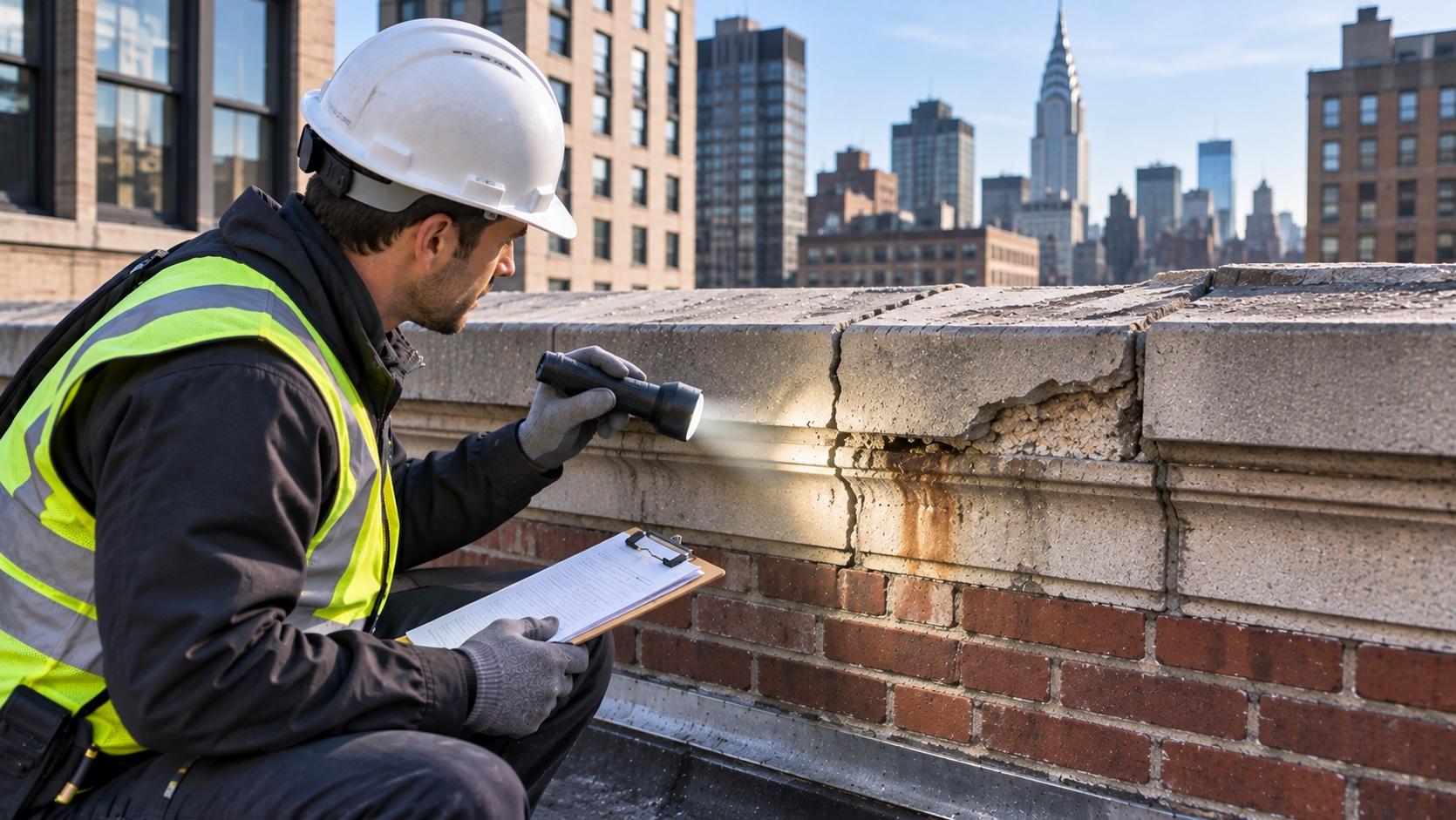
- Hands-on, close-up observation, where the inspector physically examines the parapet at the roof level — probing mortar, checking plumbness, looking for displacement, cracking, and signs of movement up close. This is the gold standard for detailed condition assessment.
- Drone-assisted inspection, which is increasingly valuable for reaching difficult vantage points, documenting conditions across long or awkward runs, and capturing high-resolution imagery efficiently.
Neither method is universally "better"; the right approach depends on the parapet's configuration, accessibility, and condition. In many cases the two complement each other, with drone imagery supporting the hands-on observation.
The output is what the owner actually needs: a DOB-ready parapet observation report documenting the inspector's findings, supported by photographs and a clear condition classification. Just as important, the record-keeping is handled for you. Local Law 126 contemplates that these annual records be retained, and VetraCheck manages six years of record retention so that your documentation is organized and available if the DOB ever asks — turning an annual obligation into something closer to "set it and forget it."
Safe, SWARMP, or Unsafe — What the Classification Means
Every parapet observation resolves to one of three classifications, and understanding them in plain English removes a lot of anxiety:
- Safe — the parapet shows no conditions requiring repair at this time. You're in good shape; the obligation simply recurs next year.
- SWARMP — short for a Safe With A Repair and Maintenance Program condition. In plain terms, the parapet is safe for now but has conditions that need to be addressed within a defined program to keep it that way. It's a signal to plan maintenance, not a crisis.
- Unsafe — the parapet has conditions that present a hazard requiring prompt attention. An Unsafe finding carries immediate obligations, including notification to the DOB and a correction clock that starts running.
The distinction between these outcomes drives everything that follows, so it's worth understanding the difference clearly before a report ever lands in your inbox. Our breakdown of what a SWARMP versus an Unsafe parapet report actually saysexplains what each result means for your next steps. The headline: a Safe or SWARMP result keeps you on a manageable path, while an Unsafe result demands quick, deliberate action.
The Consequences of Getting It Wrong (A Balanced Look)
It's worth being honest about what's at stake if the obligation is missed — grounded strictly in the real rules, without any invented figures.
Local Law 126 and 1 RCNY §103-15 carry penalty exposure for owners who fall out of compliance. Late filing of a required parapet observation can accrue penalties on the order of $1,000 per month, and uncorrected unsafe conditions can carry comparable monthly exposure for the period they remain unaddressed. Those figures stack over time, which is how a missed filing or a neglected repair can quietly grow into a substantial liability.
An Unsafe classification also triggers a defined correction obligation. Unsafe parapet conditions come with a 90-day repair timeline, within which the hazardous condition must be addressed — often alongside interim protective measures while repairs are arranged. That clock is not something to discover after the fact.
Now, the cost objection. It's common to view an inspection as an expense best deferred, and we understand the instinct — building budgets are stretched across LL126, FISP, Local Law 97, Local Law 33 energy grades, boilers, elevators, and more. But the economics deserve an honest comparison. Set the predictable, transparent cost of an annual parapet observation against the alternatives: monthly penalties that compound, the expense and disruption of an emergency sidewalk shed if an unsafe condition goes unmanaged, and the far larger bill that deferred masonry repairs tend to become once water and freeze-thaw have had their way. Inspection pricing varies with the building, but in general terms it is modest relative to those downstream costs — and it buys certainty rather than exposure.
This isn't a scare tactic. It's simple risk arithmetic, and it usually favors staying ahead of the obligation.
Borough Context — Why Local Expertise Matters
One of the quiet truths of NYC compliance is that "New York building stock" is really five distinct stories, and local knowledge matters.
Manhattan and much of Brooklyn are dense with pre-war masonry — the soft-mortar, freeze-thaw-vulnerable parapets we discussed above, often on tall buildings fronting some of the busiest sidewalks in the country. Queens and the Bronx offer a broader mix: pre-war apartment houses alongside mid-century and newer construction, each with its own parapet profiles. Staten Island's conditions vary widely, from older town centers to more recent development. A parapet on a Bronx walk-up and a parapet atop a Midtown tower are different animals, assessed with different emphases.
This is where working with a firm that knows NYC's specific DOB processes and local building context pays off. VetraCheck has performed thousands of inspections across all five boroughs and maintains a 100% compliance rate, with DOB-certified engineers and architects who understand both the regulation and the realities of the buildings it governs. Whether your property is a brownstone in Brooklyn or a mixed-use building elsewhere in the city, the value of a local expert is in getting the assessment right the first time — and getting it filed correctly.
Your Next Step — Confirm Your Building's Requirements
Here's the diagnostic lens, in summary. Your parapet's height above the roof shapes how closely its stability is scrutinized. Its material — especially if it's aging pre-war masonry — shapes what failure modes an inspector looks for. And its street frontage is the pivotal factor that, more than any other, determines whether the annual obligation applies at all. Together, under 1 RCNY §103-15, these three factors define your parapet inspection requirements as an NYC building owner.
But understanding the why is only half the work. The definitive answer — whether your parapet is covered, and how it classifies — comes from a professional inspection of your specific building. That's the step that converts uncertainty into a documented, DOB-ready position.
If a notice, a neighbor's sidewalk shed, or an approaching deadline prompted your visit here, the right move is simple: confirm your building's requirements with a qualified assessment. VetraCheck delivers fast, DOB-ready reports in 3–5 business days, handles your six-year record retention, and sends annual reminders so the obligation never catches you off guard again — genuine "set it and forget it" peace of mind.
Ready to find out exactly where your building stands? Schedule your parapet inspection or request a quote and let a DOB-certified team take the guesswork off your plate.
Official sources
- Parapets, NYC Department of Buildings
- Parapets: Frequently Asked Questions, NYC Department of Buildings
- 1 RCNY §103-15 (parapet observation rule), NYC Department of Buildings
- 1 RCNY §102-01 (penalty schedule), NYC Department of Buildings
Published by VetraCheck Inc., a New York City inspection firm. About VetraCheck
Keep reading
Need a Local Law 126 parapet inspection?
Licensed NYC engineers, dated photos, and a report in three to five business days, on file before December 31.
Parapet inspections in Manhattan, Brooklyn, Queens, The Bronx, Staten Island