
LL126 Parapet Inspections: Your December 31 Action Plan
In this article
The calendar has a way of catching building owners off guard. Summer gives way to fall, fall slides into the holidays, and somewhere in that rush, the realization lands: the year-end compliance obligations still haven't been scheduled. If you own, manage, or sit on the board of a New York City building, the Local Law 126 parapet inspection is one of those obligations that follows a calendar-year cadence — which means Q4 is precisely when a lot of owners discover they still have work to do.
Here is the reassuring part: if you act now, you still have room to do this calmly and correctly. There is no need to panic, and there is no need to treat this as a last-minute scramble. What there is a need for is a plan.
This piece is not a general primer on what Local Law 126 is. It is a time-bound action plan — a sequence of concrete steps to take between now and December 31 so your building stays compliant and your records stay in order. Along the way, we'll be clear about one important thing: whether your specific building is covered, how any findings should be classified, and exactly what you're obligated to file all depend on building-specific conditions. Those determinations belong to a qualified professional, not a guess. Think of what follows as a map, with the professional inspection as the step that confirms the terrain.
The Deadline Mechanics, in Plain English
Under 1 RCNY §103-15, New York City requires an annual parapet inspection — more precisely, an annual parapet observation — for buildings with parapets that front a public right-of-way. In plain terms, a parapet is the portion of an exterior wall that extends above the roofline. When that wall edge overlooks a sidewalk, street, or other public space where people walk and gather, the condition of the parapet becomes a public-safety matter, and the Department of Buildings (DOB) wants it observed and documented every year.
The word "annual" is doing real work here. This is not a one-time event or a multi-year cycle. It's a recurring, calendar-driven obligation, and the documentation produced each year is meant to be retained and available. That annual rhythm is exactly why year-end becomes a pressure point: owners who haven't built the observation into a routine tend to confront it all at once, in the final weeks of the year.
A note on precision, because it matters: we are not going to invent specific dates, extensions, or grace periods in this article. NYC compliance rules evolve, and the exact mechanics of filing and record-keeping can carry nuances that depend on your building and on current DOB guidance. The responsible move is to confirm your building's specific obligation with a qualified professional and, where appropriate, directly with the DOB. What we can say confidently is this: the requirement is annual, it is grounded in 1 RCNY §103-15, and it applies to buildings with parapets fronting a public right-of-way across all five boroughs. If that describes your building, the question is not whether to act but when — and "now" is the answer that keeps you in control.
Why Year-End Scheduling Gets Tight
There's a practical bottleneck worth understanding. Because the obligation runs on a calendar-year cadence, demand for inspections concentrates heavily in the fourth quarter. Across Manhattan, Brooklyn, Queens, the Bronx, and Staten Island, owners and managers tend to reach for the same inspection calendar at the same time. Qualified professionals have finite capacity, and late December is the narrowest window of the year.
Waiting until the eleventh hour means competing for scarce slots, with far less flexibility if weather, building access, or a borderline condition complicates the timeline. Acting now, by contrast, keeps the entire process calm and controlled. You schedule on your terms, you have time to arrange roof access, and if the observation surfaces something that needs attention, you have a runway to address it thoughtfully rather than reactively. Early scheduling isn't just about beating a deadline — it's about keeping the whole experience low-stress.
"Is My Building Actually Covered?"
The most common question we hear is also the most reasonable one: Does this even apply to my building?
At a high level, you can start with a simple self-assessment. Does your building have a parapet — that extension of the exterior wall above the roofline — and does any portion of it front a public right-of-way, such as a sidewalk or street? If the answer to both is yes, your building is very likely within the scope of the annual parapet observation requirement.
That said, "very likely" is not the same as "definitely," and this is not a determination to make on instinct. Coverage depends on building-specific conditions — the geometry of the structure, the orientation of its walls, the relationship between the building edge and the public space below. The final determination is something to confirm professionally, not guess at.
The New York City context makes this especially relevant. The DOB oversees a building stock that is, in many neighborhoods, remarkably old. Pre-war buildings are everywhere across the five boroughs, and parapets are a near-universal feature of that architecture. These older walls were built with materials and methods that behave differently than modern construction — soft lime mortar, freeze-thaw vulnerability, and metal anchors prone to corrosion — which is exactly why the city has focused regulatory attention on them. If you own or manage an older building with a street-facing wall edge, the odds that parapet inspection NYC requirements apply to you are meaningfully high.
LL126 Parapet Observation vs. FISP / Local Law 11
Here is a point of confusion worth clearing up, because it trips up even experienced owners. The Local Law 126 parapet observation is not the same thing as the facade inspection you may already know under FISP (the Facade Inspection Safety Program), also called Local Law 11.
FISP applies to buildings greater than six stories and operates on a multi-year cycle, requiring a comprehensive inspection of the building's exterior walls by a qualified exterior wall inspector. The LL126 parapet observation, by contrast, is an annual check focused specifically on the parapet, and its scope reaches buildings that FISP doesn't necessarily cover.
The simplest way to hold both in your head: they are overlapping but separate. A building over six stories may well have obligations under both programs — a cycle-based full facade inspection and an annual parapet observation. Satisfying one does not satisfy the other. We won't over-detail FISP here, but if you've been treating your facade cycle as your only wall-related obligation, the annual parapet requirement deserves a fresh look.
When You Shouldn't Assume
A word of caution in both directions. Just as you shouldn't assume you're exempt, you also shouldn't assume the worst without confirmation. Exclusions and edge cases exist. Some building configurations, setbacks, and wall conditions may change the analysis. The honest answer is that these nuances should be confirmed by a professional who can look at your specific situation — not resolved by a blog post issuing a definitive "you're covered" or "you're exempt" ruling. When the stakes include DOB penalties and pedestrian safety, a short conversation with a qualified inspector is cheap insurance against a costly misread.
Who Can Perform the Observation — the "Competent Person" Question
The rule is specific about who may conduct a parapet observation, but the concept translates cleanly for a non-technical reader. The observation must be performed by a "competent person" — someone with the knowledge and experience to reliably assess the condition of the parapet and document what they find. The DOB's framework is designed to ensure that the person signing off actually understands what they're looking at and can recognize the warning signs of deterioration or instability.
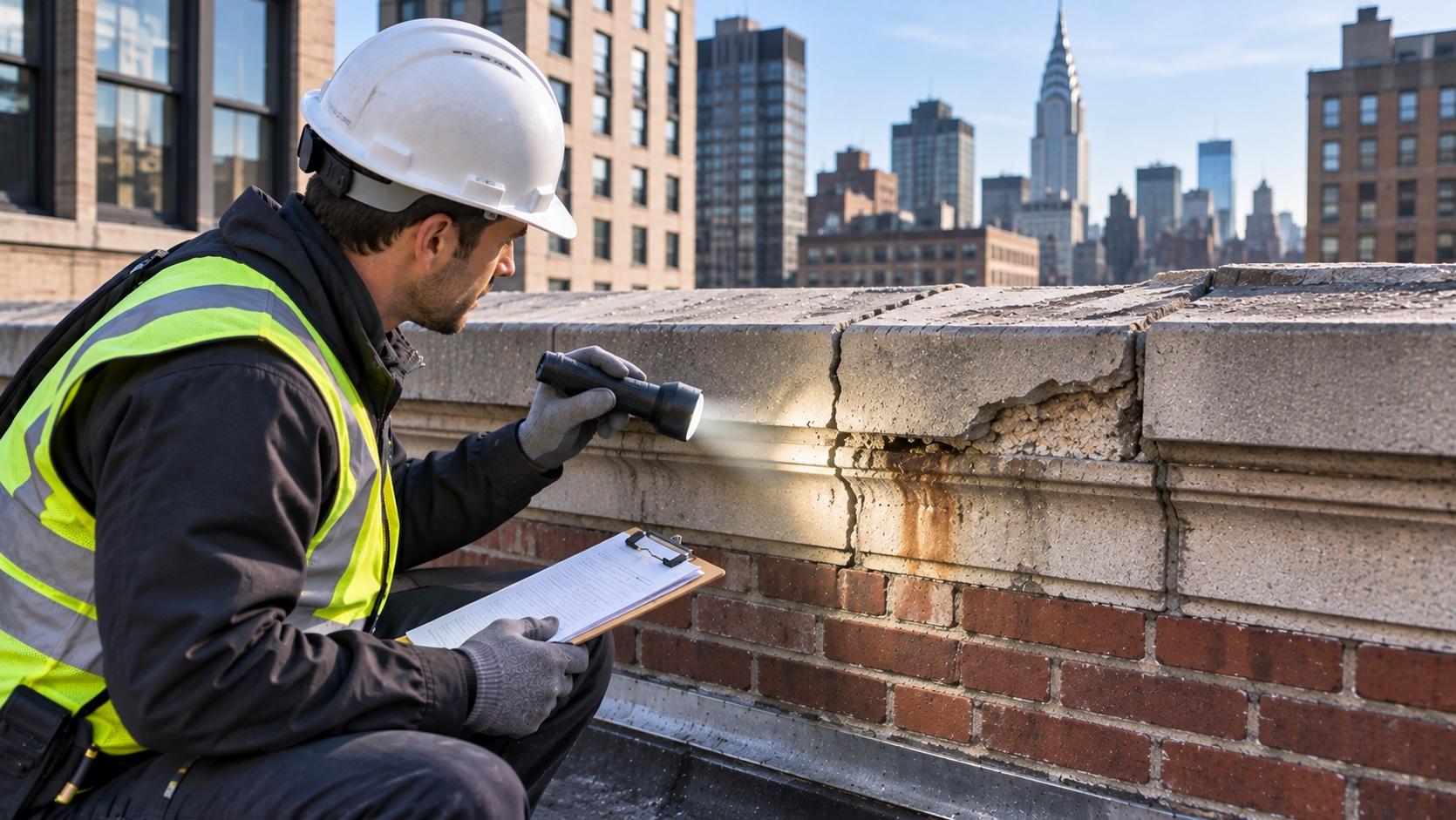
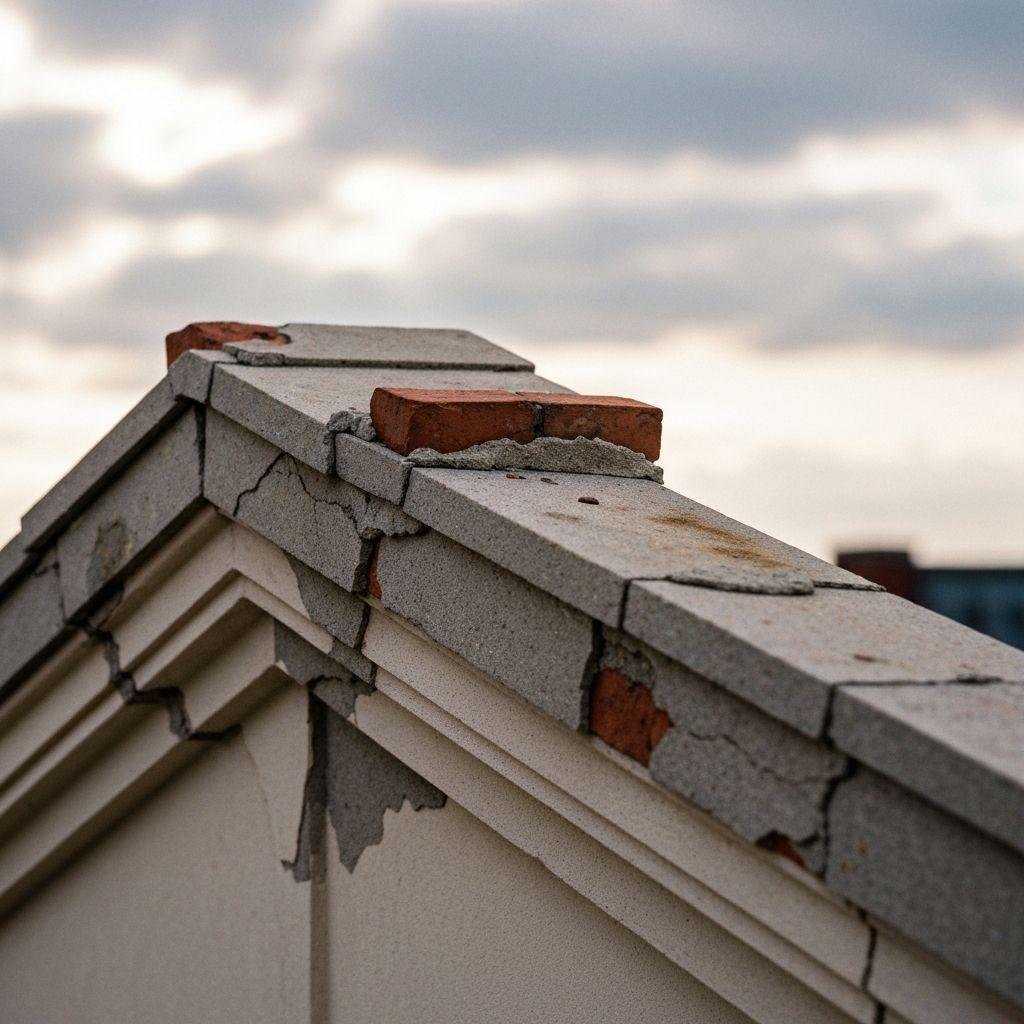
That framework exists for a reason. A parapet in distress doesn't always announce itself dramatically. The telltale signs — displaced masonry, cracked or missing mortar, bulging, corroded metal anchors, separation from the structure behind it — require an experienced eye to catch and interpret correctly. The observation is only as valuable as the judgment behind it.
"Can't My Super or Handyman Just Handle This?"
This is a fair question, and it deserves a straight answer rather than a sales pitch.
A competent person may be permitted to conduct the observation, and good supers and building staff know their buildings intimately. We're not here to diminish that. But there's a meaningful distinction between satisfying the letter of a rule and protecting yourself when a condition is borderline, worsening, or likely to be scrutinized.
When a parapet shows ambiguous signs — conditions that could reasonably be read as either acceptable or problematic — the credibility and documentation standards of a licensed engineer or architect become a genuine asset. If a finding is ever challenged by the DOB, or if a condition deteriorates and questions arise later about what was known and when, a professionally conducted and documented observation carries weight that an informal assessment may not. It's risk management, plain and simple.
This is why VetraCheck's parapet observations are performed by DOB-certified engineers and architects. The goal isn't to over-engineer a simple check — it's to make sure that when you say your building was properly observed, the record stands up to scrutiny. For an owner carrying real financial and legal responsibility for the asset, that assurance tends to be worth far more than it costs.
The Three Outcomes — Safe, SWARMP, and Unsafe
Every parapet observation resolves into one of three classifications. Understanding what each means in practice removes a lot of the anxiety around the process, because none of the three is a mystery once you know the framework.
Safe
A Safe classification means the parapet is in satisfactory condition — no significant deterioration, no instability, nothing that requires near-term intervention. This is the outcome most well-maintained buildings achieve, and it's the one everyone hopes for.
A Safe finding is not, however, a license to forget. The obligation is to continue the annual cadence and to retain your records. "Safe this year" is a statement about this year. The whole logic of an annual requirement is that conditions change over time — especially on older walls exposed to New York's freeze-thaw winters — so the observation repeats. Treat a Safe result as confirmation that your maintenance is working, and keep the routine going.
SWARMP (Safe With a Repair and Maintenance Program)
SWARMP stands for Safe With a Repair and Maintenance Program, and it's the classification owners most often misunderstand. A SWARMP designation means the parapet is currently safe but exhibits conditions that will require repair or maintenance — within a defined program and timeframe — in order to stay safe.
Think of it as an early warning rather than an alarm. The parapet isn't a present hazard, but it's on a trajectory that, left unaddressed, could become one. The practical value of a SWARMP finding is that it gives you time to plan. You can budget, schedule contractors, and sequence the work sensibly instead of being forced into emergency repairs later. For co-op and condo boards especially, this lead time is a gift: it lets you bring work into the regular capital-planning conversation rather than presenting an unexpected special assessment. The right response to SWARMP is a plan, not a panic.
Unsafe — What It Triggers
An Unsafe classification is the serious one, and it carries time-sensitive obligations. When a parapet is found to present a hazardous condition, there is a duty to notify the DOB promptly, and correction clocks and protective measures come into play. In practical terms, an unsafe parapet may require interim safety measures — such as a sidewalk shed to protect pedestrians below — while permanent repairs are arranged and completed within the required timeframe.
It's important to be precise here: the specific triggers, notification requirements, and correction timelines depend on the building and the nature of the condition, and they should be handled by a professional who understands the current DOB process. This is not a situation to navigate from a checklist.
That said, an Unsafe finding is manageable. The worst version of this scenario is one where the condition goes unnoticed or unreported — creating both a safety risk and serious liability exposure. The far better version is one where a responsive firm identifies the condition, notifies the DOB promptly as required, and guides you through the correction process step by step. Unsafe parapet conditions are precisely why the annual observation exists: to catch problems while they can still be addressed in an orderly, protective way. Finding one is the system working.
Your Year-End Action Checklist
Here is the spine of the whole piece — a sequenced plan you can start today and finish well before December 31.
Step 1 — Schedule the Observation Now
Booking early is the single highest-leverage decision you'll make in this process. It's how you avoid the late-December crunch, when inspection calendars across all five boroughs fill up fast. Reach out, lock in a date, and give yourself breathing room.
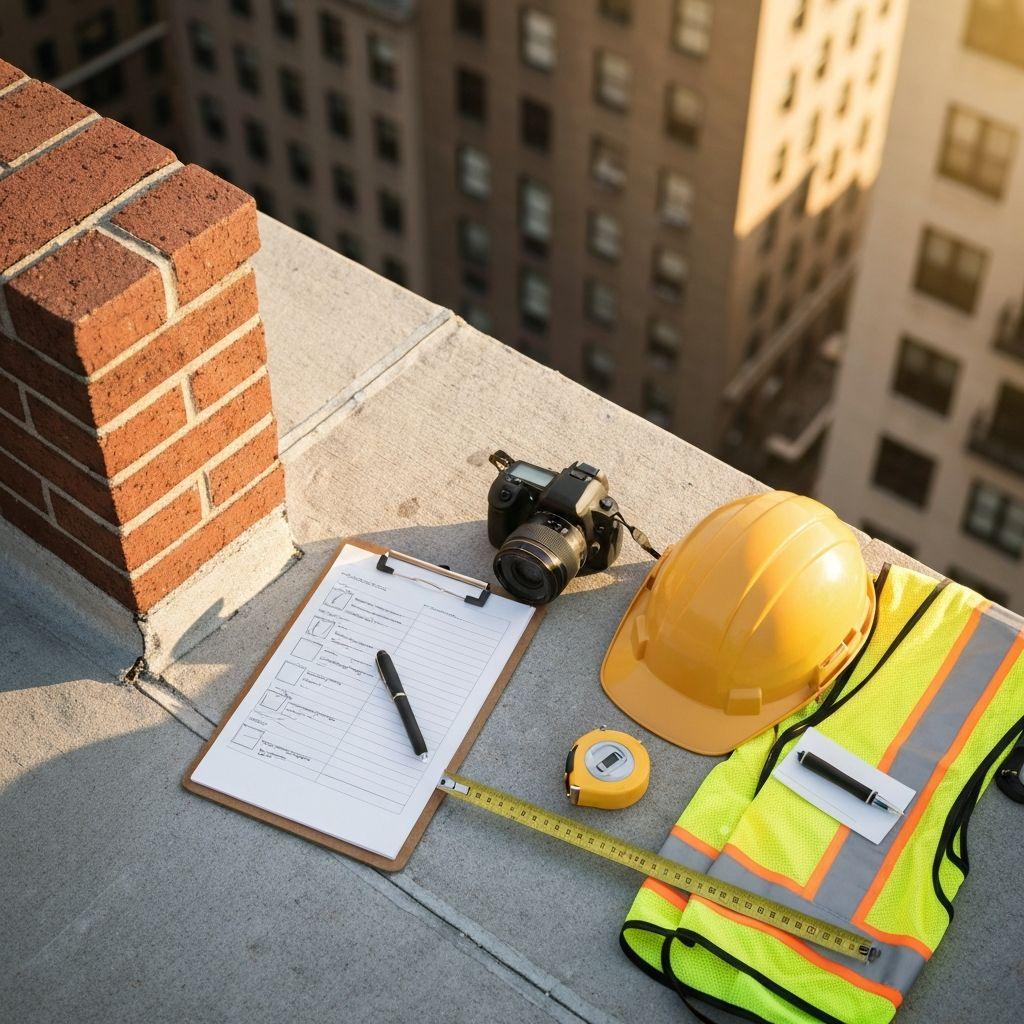
To make scheduling smooth, have a few things ready: your building's basic details (address, number of stories, a general sense of the parapet and roofline), plus your roof-access arrangements — keys, bulkhead access, and the name of whoever on-site can let the inspector in. A little preparation here saves days later.
Step 2 — The Inspection
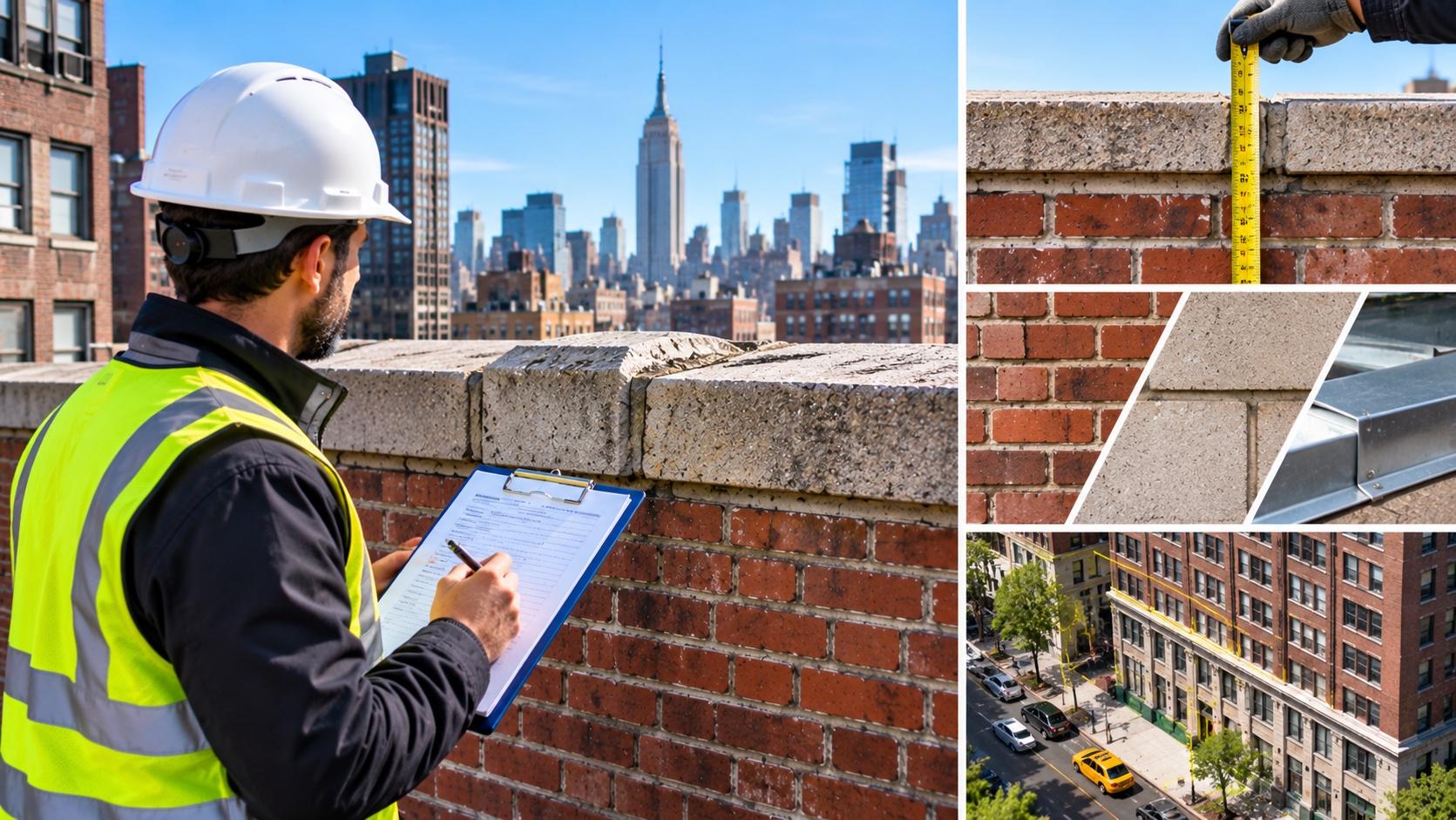
On inspection day, expect a professional, low-disruption process. A thorough parapet observation typically combines hands-on examination of accessible conditions with, where appropriate, drone-assisted observation of areas that are difficult or unsafe to reach directly. Drones have become genuinely useful for capturing clear, detailed imagery of upper wall conditions without extensive rigging.
For tenants, the impact is minimal. The work is concentrated at the roofline, and most occupants won't notice it's happening at all. There's no need to disrupt residents or clear out common spaces for a standard parapet observation.
Step 3 — Get a DOB-Ready Report (3–5 Business Days)
A completed observation is only as useful as the documentation behind it. A proper, DOB-ready report includes photographs of the parapet's condition, a written record of what was observed, and the correct classification — Safe, SWARMP, or Unsafe — applied to the findings. This is the document that proves the work was done and done properly.
Turnaround matters enormously near year-end. VetraCheck delivers DOB-ready reports within 3–5 business days, which means that even if you're scheduling into the later part of the quarter, you still have time to handle any filing and record obligations before the window tightens. A fast, complete report is the difference between finishing comfortably and racing the clock.
Step 4 — File and Retain Records
Once you have your report, there are filing and record obligations to satisfy, grounded in the requirements of 1 RCNY §103-15. We won't invent the specifics here — the exact mechanics can vary and should be confirmed for your building — but the principle is straightforward: the observation must be properly documented, the appropriate records maintained, and any required submissions handled. A good inspection partner will make sure nothing in this step falls through the cracks.
Step 5 — Calendar Next Year
The final step is the one that pays dividends for years. Set an annual reminder now, while it's top of mind, so next year's observation gets scheduled early rather than rediscovered in a December scramble. The goal is to turn an annual obligation into a quiet, repeatable routine — "set it and forget it" peace of mind. Once the cycle is running smoothly, the year-end deadline stops being a source of stress entirely.
Penalties and the Real Cost of Waiting
Let's talk honestly about what's at stake if the observation slips, without resorting to scare tactics.
The DOB's enforcement framework includes penalty exposure for failing to meet compliance obligations — both for late filing and for uncorrected conditions that go unaddressed. These penalties can accrue over time, which is the key feature to understand: they are not always a single fixed charge but can build month over month until the obligation is satisfied. Because the specifics can change and depend on the situation, the exact figures and timelines should be confirmed against current DOB guidance rather than assumed. The responsible takeaway is directional, not precise: delay tends to get more expensive, not less.
Now reframe the cost of the inspection itself. A timely parapet observation is a modest, predictable expense — the kind of routine line item that fits neatly into an operating budget. Set against accruing penalties, the emergency expense of an unplanned sidewalk shed, and the way deferred repairs compound into larger problems, a scheduled observation is one of the better values in building compliance. VetraCheck keeps pricing transparent and predictable, with no hidden fees, precisely so owners can plan around it with confidence.
None of this is cause for alarm. It's simply the arithmetic of staying ahead versus falling behind. The buildings that treat the annual observation as a planned, budgeted routine almost never face the penalty-and-emergency scenario at all. That's the whole point of acting on time.
Why Record-Keeping Matters More Than Owners Think
Documentation is the unglamorous part of compliance, and it's also where a surprising number of owners stumble. The rule contemplates retaining inspection documentation over a multi-year period, and that retention requirement exists for good reasons beyond simple box-checking.
Organized records matter for future filings, because each year's observation sits within an ongoing history. They matter for DOB inquiries, because if a question ever arises about your building's condition or compliance status, well-kept records are your clearest, fastest answer. And they matter for ownership transfers and refinancings, when buyers, lenders, and their advisors want proof that the building's compliance obligations have been met consistently.
For co-op and condo boards, record-keeping carries an additional dimension: continuity. Board membership turns over. Managing agents change. Institutional memory is fragile. A clean, organized record of annual parapet observations protects the building's compliance posture across all that turnover, so a new board isn't left reconstructing history or wondering what was done three years ago. Proper record retention is a quiet form of protection — the kind you're grateful for precisely when you need it most.
What a Smooth, Done-for-You Process Looks Like
When the process is handled well, compliance stops feeling like a burden and starts feeling like something that simply gets taken care of. That's the experience worth aiming for.
In practice, it looks like this: responsive scheduling across all five boroughs, so you're not waiting weeks for a callback. Observations performed by DOB-certified engineers and architects, so the work carries professional weight. A combination of drone-assisted and hands-on methods, so the parapet gets a thorough look without unnecessary disruption. Fast, 3–5 business day DOB-ready reports, so you're never racing the calendar. Prompt DOB notification if an Unsafe condition is found, so time-sensitive obligations are met without delay. And handled record retention, so the documentation you'll need later is simply there when you need it.
The credibility behind that experience matters. VetraCheck has completed thousands of inspections across New York City, maintains a strong compliance track record, and keeps pricing transparent so there are no surprises. Those aren't just reassurances — they're the practical reasons the process runs smoothly.
Built for Busy Owners, Managers, and Boards
If you're reading this, you're almost certainly juggling more than parapets. Local Law 126 shares your calendar with FISP, Local Law 97's emissions requirements, Local Law 33's energy grades, boiler inspections, elevator inspections, and whatever else your building demands this quarter. Each one has its own deadline, its own paperwork, and its own penalty for slipping.
The value of a done-for-you parapet observation is that it removes one recurring item from that stack entirely. One obligation, handled reliably, year after year, with reminders so you don't have to hold the date in your head. In a compliance landscape this crowded, subtracting a recurring headache is worth a great deal.
Don't Let the Calendar Decide for You
The December 31 cadence is entirely manageable — if you act now. The core message of this piece is simple: the mechanics of the Local Law 126 parapet inspection aren't the hard part. The hard part is timing, and the single biggest risk is waiting until scheduling and filing windows tighten in the final weeks of the year. Early action turns a potential scramble into a routine.
A final, important reminder: whether your building is covered, how any findings should be classified, and exactly what you're obligated to file are all building-specific questions. Nothing in this article is a definitive ruling on your particular property. The right way to resolve those questions is through a professional observation by a qualified engineer or architect who can assess your building's actual conditions.
So take the one step that makes everything else fall into place. Book a Local Law 126 parapet inspection — or request a quote — now, and get a clean, DOB-ready report well before year-end. Your building, your tenants, the pedestrians below, and your own peace of mind will all be better for it. Don't let the calendar decide for you.
Official sources
- Parapets, NYC Department of Buildings
- Parapets: Frequently Asked Questions, NYC Department of Buildings
- 1 RCNY §103-15 (parapet observation rule), NYC Department of Buildings
- 1 RCNY §102-01 (penalty schedule), NYC Department of Buildings
Published by VetraCheck Inc., a New York City inspection firm. About VetraCheck
Keep reading
Need a Local Law 126 parapet inspection?
Licensed NYC engineers, dated photos, and a report in three to five business days, on file before December 31.
Parapet inspections in Manhattan, Brooklyn, Queens, The Bronx, Staten Island